
I will share about Christian books I have read or listened to.
I will be sharing about my life before and after Christ. I will include stories about my pet and other pets I have encountered.

From Promises to Fulfilled Covenants
God made promises to Abraham in Genesis about his lineage, and He gave the Ten Commandments to Moses in Exodus. He made a covenant to David in 2 Samuel, and declared a New Covenant to come in the book of Jeremiah (Jeremiah 31:31-34).
All of those stories point to the arrival of Jesus Christ—where all God's covenant promises are fulfilled (2 Corinthians 1:20).
These stories remind us of God’s faithfulness (Romans 15:4). We don't have to look very far to see:
"That the Lord your God is God; he is the faithful God, keeping his covenant of love to a thousand generations of those who love him and keep his commandments."
Deuteronomy 7:9
God's love is faithful; it is constant. It endures through the generations. In a world where love is often conditional and transactional, given and withdrawn based on our actions, God's love stands apart. It's not tethered to the ups and downs of our circumstances. It doesn't waver with our feelings. And it certainly doesn't hinge on our performance.
God's love is firmly rooted in His unchanging character.
So even if you're on the highest mountaintop of success or in the deepest valley of despair—His love remains constant, an ever-present source of strength for those who love Him.
Today, let the words of Deuteronomy 7:9 sink deep into your soul and remember: Our God is not distant or indifferent. He is near, and His love is faithful, enduring through a thousand generations.
Proverbs 16
English Standard Version
16 The plans of the heart belong to man,
but the answer of the tongue is from the Lord.
2 All the ways of a man are pure in his own eyes,
but the Lord weighs the spirit.[a]
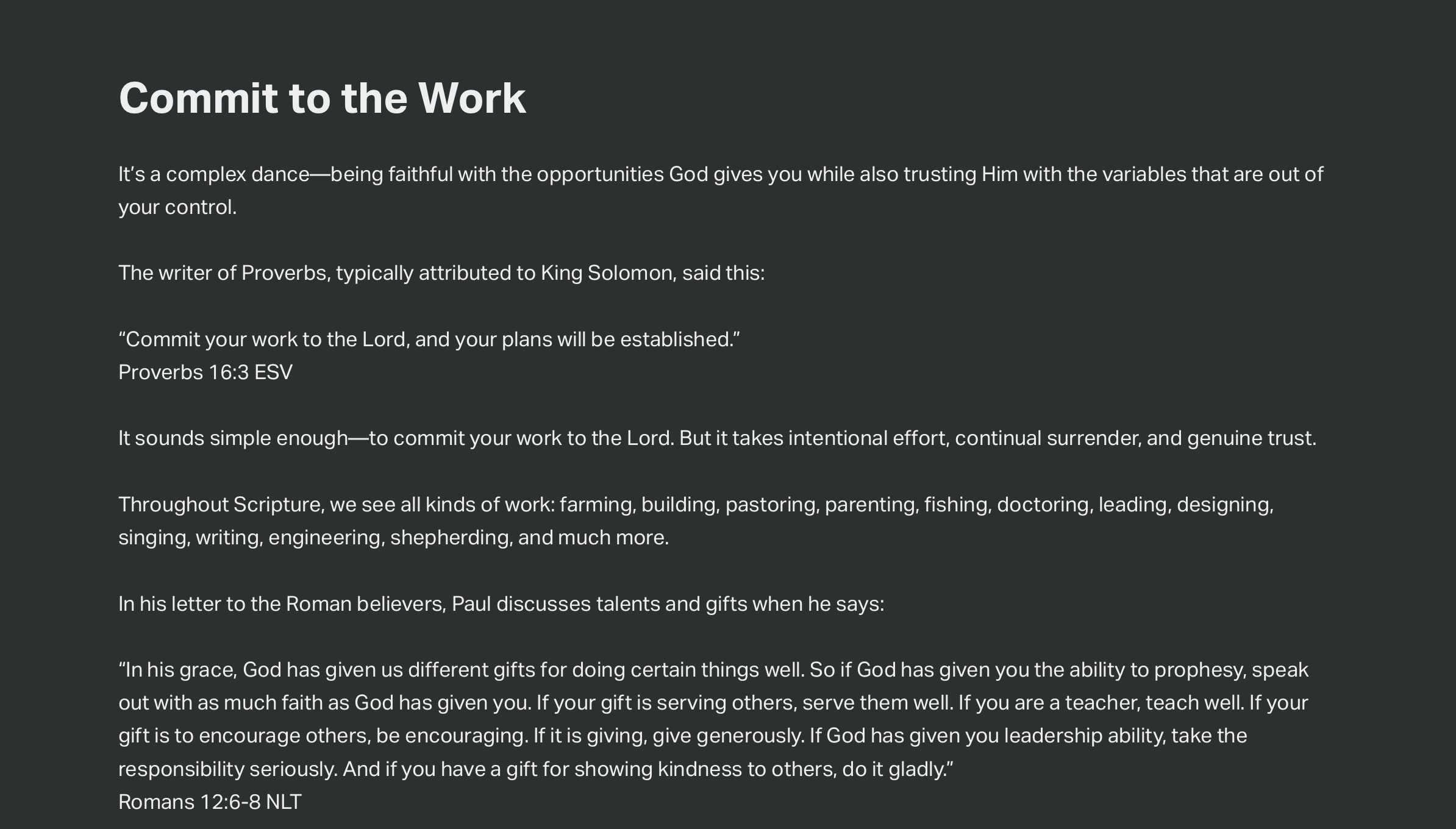
3 Commit your work to the Lord,
and your plans will be established.
4 The Lord has made everything for its purpose,
even the wicked for the day of trouble.
5 Everyone who is arrogant in heart is an abomination to the Lord;
be assured, he will not go unpunished.
6 By steadfast love and faithfulness iniquity is atoned for,
and by the fear of the Lord one turns away from evil.
7 When a man's ways please the Lord,
he makes even his enemies to be at peace with him.
8 Better is a little with righteousness
than great revenues with injustice.
9 The heart of man plans his way,
but the Lord establishes his steps.
10 An oracle is on the lips of a king;
his mouth does not sin in judgment.
11 A just balance and scales are the Lord's;
all the weights in the bag are his work.
12 It is an abomination to kings to do ...